坎 · Water · Faunus
☵ Kan — Reserves
The sacred ache of being alive. Kan is the part of you that wants to feel something primal and real before time runs out, and the part that knows how to keep life going when everything else has been spent.
The Trigram
A single Yang line hidden between two Yin lines. Light concealed in darkness. This is the structure of Water in the Yijing: water that enters the abyss and keeps going. Kan is the trigram of repeated danger, and the sincerity that survives it.
習坎,有孚,維心亨。
Repeated abyss. There is sincerity. Only through the heart can there be success.
Kan is Reserves, vitality turned inward. Where its polar opposite Dui shares life outward as warmth and connection, Kan draws life inward to protect it, restore it, and deepen it. It is the part of a person that knows what they need to stay alive, and in the fullest sense: actually being here, actually feeling the weight and sweetness of a mortal life.
This is the power of receptive vitality. It replenishes rather than performs. It is the well that other people drink from without knowing it’s there.
The Power
You know the feeling of being near someone who is actually present, warm, in their body, in the moment, with no need to perform or manage the room? That is Kan working. It’s the capacity to be in contact with the world as it actually feels, without needing to turn it into something else first.
People strong in Kan have a bodily sincerity to them. They know what nourishes them and what drains them, and they orient their lives around that knowledge with quiet stubbornness. They make a room feel safe by being in it. There’s a primal trust in their presence, a willingness to want things, to enjoy things, to need things, without apologizing for it.
In relationships, they offer something sacred and simple: the warmth of someone who is actually here. People feel held around them, even when nothing is being said. They struggle when the world demands they leave their ground, when sincerity isn’t enough, when the pace won’t slow, when nobody has time to just be.
Under strain, the same pull that connects Kan to life becomes appetite that swallows it. Desire turns to possessiveness, the attempt to collect and hold what can only be met in passing. The garden becomes a hoard. Or they go numb entirely, cut off from the very aliveness that defines them. Panic, secrecy, compulsive indulgence, dependency: these are Kan’s distortions. They come from hunger, from someone who feels too much to bear feeling nothing.
The deepest fear here is depletion. Being drained of everything vital, with nothing left and no one to replenish it. The deepest work is learning to keep wanting without grasping, to let desire remain an opening rather than a mouth.
The Image
Doe-eyed with the mouth of a wolf. Wide, sincere eyes that take in the world with an almost unbearable openness, and beneath them, an appetite that could swallow it whole. The softness is real. The hunger is real. They coexist. Emotional, intense, headstrong, pensive, melancholic, prone to depression, with an inclination toward esoteric knowledge and soft features.
In nature, Kan is water in its darker and more life-bearing forms. Rivers cutting through stone. Hidden springs. Night water. Caves where sound carries differently. Meadows after dew, when everything is heavy and glistening and impossibly alive. Coastlines, the sea, bodies of water in all their forms. Heavy rains, snow, gloomy weather, dew, frost. The sound of mantra recitations, prayers, minor keys, lamentations, nocturnes. Medicines, healing soups, dark mirrors. Channels and ditches, that which is hidden and concealed.
Faunus & Pan
The Romans called this power Faunus, the horned god of fertility, fields, forests, and all wild, living things. He is depicted as a young man with goat’s horns, goat’s legs, and a human torso, half-animal and half-divine, fully at home in both worlds. They called him the Kindly One, the Speaker in Rustling Leaves, the Voice of the Wild. His festival was the Lupercalia, the ancient rite of February where priests ran through the streets striking people with strips of goat hide to bring fertility, health, and purification. As god of prophecy, he spoke through dreams and through the sounds of the forest: cracking branches, birdsong, the rush of water over stone. As god of the flocks, he protected everything that grows, breeds, and feeds on open land. Sacred to him are the goat, the wolf, the woodpecker, and the fig tree.
The Greeks knew him as Pan (Πάν), the half-animal god of woods, meadows, and mountains, whose curved shepherd’s staff traces the cycle of life. Pan invented the syrinx, the reed flute, from the body of a nymph he loved who transformed to escape him. This captures the Kan story in a single image: desire that cannot possess what it wants, and makes music from the loss. Pan’s other gift was panic, and the word itself comes from his name. It is the sudden terror that strikes in wild places, the feeling that something enormous and alive is watching you from the trees. This is the other side of Kan’s sincerity: the overwhelming force of contact with something too real to manage.
Faunus is found in every image of paradise: Eden, Shangri-La, Arcadia, Elysium. Streams of milk and honey. Where all the heart desires is present. The Egyptians knew this power as Min, the god of fertility and harvest, depicted fully aroused, with desire understood as a sacred force. The Sumerians knew it as the garden of Dilmun, where Enki and Ninhursag created the world through longing. Faunus is the wistful, wild sincerity of the creature who knows it will die and wants to be alive anyway. The warmth of sun on skin when you know the season is turning. Every paradise image carries this undercurrent: the garden is beautiful because you cannot stay.
Avalokiteshvara 觀世音菩薩
In the Buddhist tradition, Kan appears as Avalokiteshvara (觀世音菩薩, Guān Shì Yīn Púsà), or Kuan Yin, meaning “Perceiver of All Sounds,” the one who hears every prayer and cry for help. Avalokiteshvara is the emanation of mercy and compassion. In China, Kuan Yin is most often depicted as female, wearing a white robe. Kuan Yin is a miracle worker who will assist anyone who calls, unconditionally, without condition of offerings, worship, or devotion. The Great Compassion Mantra 大悲咒 (Dà Bēi Zhòu) is recited to purify karmic merit, facilitate a peaceful transition to the afterlife, and for spiritual healing, consecration, or purification. A shorter mantra for invoking Avalokiteshvara: oṃ mani padme hūṃ. Invocation in Mandarin: 南無觀世音菩薩 (námó Guānshìyīn Púsà). Avalokiteshvara’s thousand hands are gestures of availability, the willingness to remain in contact with pain without being destroyed by it.
Li Tie Guai 李鐵拐
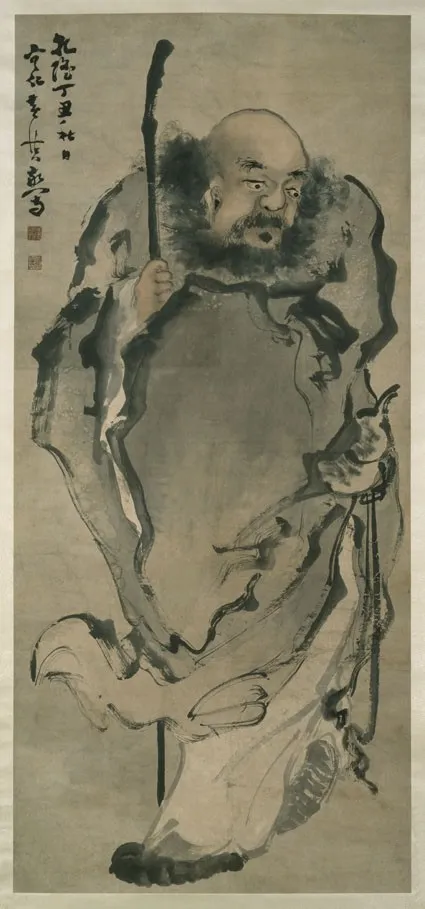
Among the Eight Immortals, Kan takes the form of Li Tie Guai (李鐵拐), the iron-crutch immortal. He achieved immortality through merit and perseverance, seeking out many different masters to study under them. He renounced materialism and became a beggar. Then he retreated into a cave to cultivate, isolated for forty years as an ascetic hermit until he finally awakened.
In one mythical telling, Li Tie Guai was a young, handsome man born into wealth and privilege who retreats into a cave to cultivate himself. While deep in meditation and astral journeying, his spirit leaves his body for seven days, causing a passerby to assume that Li had died. His body is cremated. When his spirit returns, he finds his body in ashes. The spirit searches for a body to occupy and finds a beggar. Li enters the body of that beggar and thus loses his previous handsome form, thereafter appearing rotund, with a disheveled face, walking with an iron crutch. This is the Kan story: depth that has passed through damage, beauty that has been broken and reassembled from the inside, power that doesn’t look like power.
His iron crutch can transform into a dragon, and the Chinese dragon’s association with water, especially the deep seas and the realm of the Dragon King, connects Li Tie Guai’s powers to the trigram Water. Water possesses strong metaphysical shapeshifting qualities, and Li’s origin story of losing his former body and having to occupy a new one is pure Water qi. During his civilian life he was an herbalist and pharmacologist, where water is the vehicle for most medicinal preparations. His symbol is the medicine gourd (葫蘆, húlu), filled with magical medicine pills. He became a patron divinity of physicians and those in the medical profession, and is also associated with advocacy against social injustice and oppression. The legendary accounts center on helping ease the suffering of the sick, the poor, and the downtrodden. Water is the abyss, and it is also what cures you.
Xuanwu 玄武
The patron divinity is Xuanwu (玄武), the Dark Warrior of the North: turtle and serpent intertwined, the guardian of winter, hidden reserves, and the deep stillness from which spring eventually returns. The occult archetype is the Healer, one whose power comes from understanding what restores life, and also from forms of vengeance magic to rectify harms and restore justice. The trigram of the blood, the trigram of the shapeshifter.
The Body
In the body, Kan corresponds to the kidneys, the officials of strength (作強之官), the storehouse of Jing (精, essence), the root of all Yin and Yang. Everything begins here and returns here. When the kidneys are full, there is endurance, fertility, quiet confidence. When they are depleted, there is fear, exhaustion, and the feeling that life is running out.
The Polar Pair — ☱ Dui
Kan and Dui are the two faces of Vitality. Kan gathers, protects, and replenishes life from within. It is the garden that receives. Dui circulates that same life outward as warmth, delight, and generous exchange. It is the sovereign who gives. Kan is the reserve. Dui is the offering. Together they form the complete axis of what it means to be alive: the inward drink and the outward pour.
Correspondences
| Trigram | ☵ Kan · 坎 · Water |
| One-word name | Reserves |
| Polarity | Receptive |
| Dynamic | Shao Yin (Receptive + Native) |
| Realm | Connective |
| Family | Vitality |
| Direction | North |
| Wuxing | 水 Water |
| Organ | 腎 Kidneys (Shen) — Official of Strength |
| Body | The ears |
| Planetary god | Faunus / Pan |
| Bodhisattva | Avalokiteshvara (觀世音菩薩) |
| Immortal | Li Tie Guai (李鐵拐) |
| Patron divinity | Xuanwu (玄武) · the Dark Warrior of the North |
| Occult archetype | Healer |
| Ritual tool | Longevity gourd |
| Zodiac animal | Rat |
| Totemic animal | Boar |
| Moon phase | Third quarter |
| Zodiac sign | ♉ Taurus |
| Qi quality | Reserves, preservation, regeneration, fertility, healing, concealment, depth |
| Landscape | Rivers, coasts, groves, caves, hidden springs, meadows, hospitals, wharves |